

It’s your first week as General Counsel (GC), and your calendar is already packed. Sales wants to know when the master agreement will get refreshed, the CFO has questions about outside counsel spend, two members of the team are eagerly wanting to discuss career progression, and someone from procurement keeps emailing about a vendor onboarding that’s been at a halt for a month.
When this happens, it’s tempting to jump straight into solutions. After all, early quick wins are important, especially in the first 90 days when goodwill is highest. But the wins that compound are the ones grounded in a clear understanding of how the function actually works, not the version you’ve inherited in the onboarding process.
The first 90 days give you something you will never have again in this role: fresh eyes, no skin in the existing setup, and permission to ask basic questions without looking out of touch. Use them deliberately.
How to Approach Your First 90 Days as General Counsel
Most playbooks for new GCs and Legal Ops leaders emphasize action. For instance, stakeholder meetings by day 30, quick wins by day 60, and a roadmap by day 90. That structure has merit. However, the quality of those decisions depends on how clearly you can see the function when you make them.
The diagnostic phase should run at the same time as the action phase. As you familiarize yourself with business procedures and secure quick wins, also carry out a parallel review focused on four key questions:
- How does legal work enter the function?
- Where does it slow down?
- What is different between the tech stack on paper and the one being used in practice?
- How does the business actually experience legal?
By day 91, the action plan you would have written on day one and the one you write at the end of the diagnostic should look meaningfully different. If they look identical, you’ve either inherited a function in unusually good shape or missed something. The gap between those two plans is the practical value of the window, and it closes quickly once you become part of the system you’re trying to read.
The two tracks of a 90-day diagnostic
| Days 1–30 | Days 31–60 | Days 61–90 | |
|---|---|---|---|
| Action | Stakeholder meetings | Early quick wins | Draft roadmap |
| Diagnostic | Map how work enters the function | Trace cycle time and handoffs | Audit stack and business view |
By day 91, the diagnostic track turns the action track’s roadmap into one grounded in evidence rather than inherited assumptions.
How to Audit Legal Intake in a New Role
Legal intake is the most revealing signal of legal’s operating health. If you can see demand clearly, every other diagnostic gets easier.
In most legal functions, intake happens across email, Slack DMs, meetings, calendar holds, and the occasional ticket. That fragmentation has consequences: prioritization tends to follow whoever asks loudest, team time gets allocated more by reaction than by design, and some categories of work have no defined entry path at all. People route around the system because the system isn’t really there.
A practical exercise for the first month is to ask each team member to log every request they receive for ten working days. Make note of the channel, requester, work type, and claimed urgency versus real urgency. What you’ll typically find is that one or two stakeholders consume disproportionate capacity, “urgent” is a label most requests carry and few qualify for, and the work types nobody tracks are often the ones generating the most friction downstream.
A structured intake layer, often called a legal front door, is what makes this visibility durable and consistent. It captures automatically requests with the right context, triages by priority and risk, and routes work into the systems and people best placed to handle it, without forcing the business to change how they engage legal.
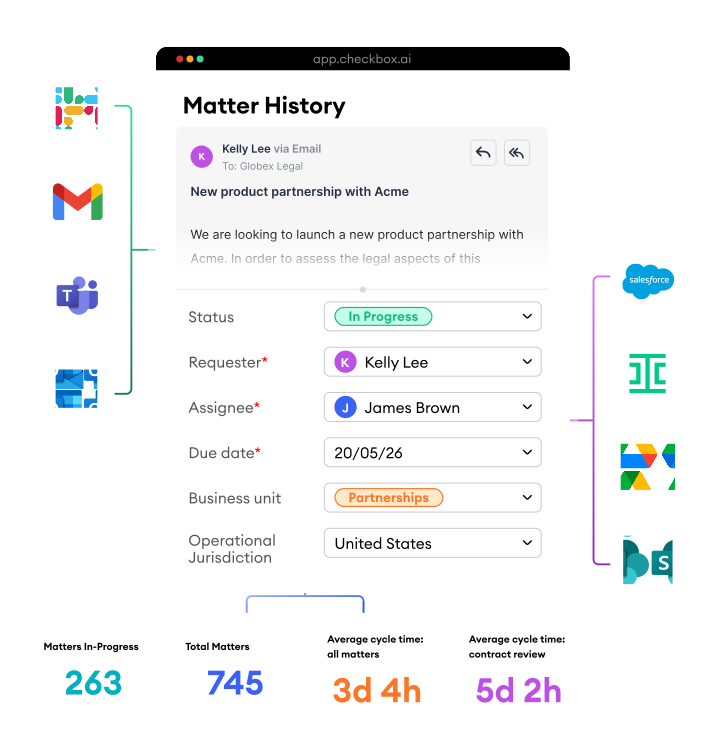
How to Measure Legal Cycle Time and Spot Bottlenecks
Cycle time is the second diagnostic. The headline number tells you something useful, but the shape of where work gets stuck tells you more.
A vendor agreement that takes 47 days isn’t necessarily a legal problem. The work might sit with the requester for 30 of those days waiting for missing information. It might bounce between procurement and finance. It might be flagged for review and then never picked up because nobody owns the queue. The total is the same in each case, and the fix is completely different.
Trace three or four representative matters from intake to close and note every transition along the way. Who picks it up, who waits on whom, and where it sits unmoved for days. And watch for the silent backlog: work that’s been “in progress” for weeks because nobody flagged it as stuck.
How to Evaluate an Inherited Legal Tech Stack
A lot of useful insight comes from the difference between how something is planned and how it actually gets used day to day.
Corporate legal teams, like most functions, accumulate tools over time. Each one is purchased to solve a specific problem, set up by people who may no longer be around, and then unevenly adopted. Some features become part of daily workflows, while others are forgotten. Meanwhile, the vendor contract continues to be paid, quarter after quarter, regardless of how much value the tool is delivering.
Because of this, a traditional survey approach tends to reinforce the illusion that everything is working as intended. When people are asked which tools they use, they often describe the stack as it should function, not how it actually operates. A better approach is to have them walk through a recent task and observe what they open, switch between, and rely on in real time.
Viewed this way, certain patterns start to emerge: a CLM exists but contracts are stored elsewhere, a matter management system is used inconsistently across the team, or dashboards appear in quarterly reviews without shaping weekly decisions. These are signals of a broader disconnect between design and reality.
So, at this stage, the goal isn’t to decide what to keep or remove. Moving too quickly risks overcorrecting based on incomplete information. Instead, the focus in the first 90 days is to map the gap clearly and comprehensively, so that any future decisions are grounded in actual usage rather than inherited assumptions.
What Sales, Procurement, and HR Reveal About Legal’s Operating Health
The most complete view of legal’s operating health comes from pairing the inside view with the business view. Spend time with the heads of sales, procurement, HR, and product. Go in with concrete questions rather than open-ended ones. How long does a typical contract take from their side? Do they know who to send what to? Have they quietly adjusted their process around how legal currently runs? What workarounds exist that they’ve stopped mentioning because they’ve become normal?
In-house legal teams tend to evaluate themselves on effort and complexity. Business stakeholders evaluate legal on responsiveness and predictability. Both perspectives are valid and both are incomplete. The interesting signal is where they diverge, because that’s where expectations and reality have drifted apart without anyone calling it out.
Diagnostic findings worth capturing: procurement describing legal as a black box, sales running a Slack channel of workarounds, HR routing employment questions to outside counsel because the internal path feels too heavy. None of these are indictments of the existing team. They’re inputs. The early conversations where the business feels heard are also the ones that buy you patience for the changes that come later.
Key Takeaways: What You Should Know By Day 91
Quick wins in the first 90 days matter, and the best new hires deliver some. The wins that compound, though, are the ones grounded in a clear read of intake, cycle time, stack reality, and business perception. Without that read, even good initiatives can optimize the wrong thing.
By day 91, you should have an extensive understanding of where demand exists and where it is increasing, where friction occurs and why, which tools are genuinely useful and which add little value, and where business trust is strong versus where it is lacking.
Want to know how other legal leaders have approached the same questions? Schedule a call with one of our technology consultants today.



.png)